Swissi
InsAI
Formal Multi-Agent AI System Architecture for Regulated Insurance Firms
A production-ready multi-agent system that models insurance firms as distributed decision systems, translating core profit and risk functions into operational optimisation engines. The platform enables insurers to simulate, monitor, and optimise underwriting, capital allocation, and regulatory constraints in real time.
"Compliance is not an external layer but embedded into the decision logic itself. Every agent action is validated against regulatory admissibility before execution."— InsAI Research Team
Insurance AI is fragmented—task-specific tools optimising local metrics without institutional objectives or regulatory constraints. Solvency II, AI Act, GDPR create compliance burden.
Formal multi-agent architecture grounded in Arrow, Nash, and Principal-Agent theory. Embedded regulatory compliance with full auditability and persistent decision memory.
The Problem
Fragmented AI Applications
Existing AI solutions in insurance focus primarily on operational subdomains—fraud detection, customer profiling, claims triage. These task-specific implementations optimise local performance metrics without incorporating institutional objectives or regulatory constraints.
Regulatory Complexity
Insurance firms in Austria and Germany operate under Solvency II, the AI Act, GDPR, the Insurance Distribution Directive, and ESG-related frameworks. Conventional models treat compliance as an external layer, failing to integrate institutional constraints into core decision processes.
Theoretical Foundations
The framework synthesises three core theoretical perspectives from economic theory to model insurer behaviour as constrained optimisation problems.
Arrow's Risk Pooling
Formalises risk transformation under uncertainty. Insurance as a mechanism for transferring individual uncertainty into collective stability through risk pooling under incomplete information and risk aversion.
Nash Equilibrium
Models strategic interactions between decision agents. Each firm maximises its own expected utility conditional on competitors' strategies, defining equilibrium where no insurer has incentive to deviate unilaterally.
Principal-Agent Theory
Addresses incentive alignment under information asymmetry. Captures hidden information (adverse selection) and hidden actions (moral hazard) between insurers and policyholders, and within firm governance structures.
Data-Driven Decision Architecture
Each agent operates under local decision rules bounded by firm-level constraints. While agents act semi-independently, they are coordinated through a global optimisation logic that enforces regulatory admissibility, risk exposure boundaries, and capital adequacy.
Large language models provide a natural interface layer for employee and client communication, enabling agents to interact with users in transparent, interpretable terms while supporting broader governance objectives.

Multi-Agent Architecture
The insurance firm is decomposed into specialised agents, each representing distinct functional domains with specific constraints, data privileges, and decision logic.
Capital Management
Maintains solvency while supporting business growth. Allocates capital across risk-bearing units under Solvency II requirements.
Underwriting
Selects, prices, and classifies risks. Maximises underwriting profit while respecting capital exposure constraints.
Claims Handling
Assesses, verifies, and settles claims. Ensures fair payment while preventing overcompensation and fraud.
Fraud Detection
Monitors for anomalous patterns. Identifies high-risk cases while minimising false positives.
Compliance & Legal
Enforces regulatory admissibility. Validates decisions against Solvency II, AI Act, GDPR, and ESG rules.
Employee Interface
Controlled gateway for personnel. Role-based access to agent outputs with audit traceability.
Stakeholder Interface
Manages external access for regulators, auditors, and shareholders with tiered visibility.
Client Service
Personalised communication for policyholders. Coverage, claims, and contract information.
Client Acquisition
Engages prospects and pre-filters applications. Product mapping and regulatory pre-contractual information.
System Orchestrator
Supervisory layer ensuring global consistency. Validates inter-agent alignment and institutional coherence.

System-Wide Intelligence
A unified optimisation structure integrates both internal decision agents and human interface agents within a single analytical expression. This enables the orchestration layer to assess the joint admissibility of all agent actions and user queries before execution occurs.
Nothing proceeds until the orchestrator has verified that every action and answer fits together without breaking any legal or operational rule—ensuring the AI system behaves like one coherent institution.
Regulatory Framework
Compliance is not an external layer but embedded into the decision logic itself.
Solvency II
Market-consistent valuation, capital adequacy, and risk-based supervision. VaR constraints at 99.5% confidence level for solvency thresholds.
AI Act & GDPR
Algorithmic accountability, data protection obligations, and auditability requirements. Traceable decision logs within 24-72 hours of execution.
IDD & ESG
Insurance Distribution Directive for consumer protection. EU Taxonomy and SFDR for environmental screening and sustainability disclosures.
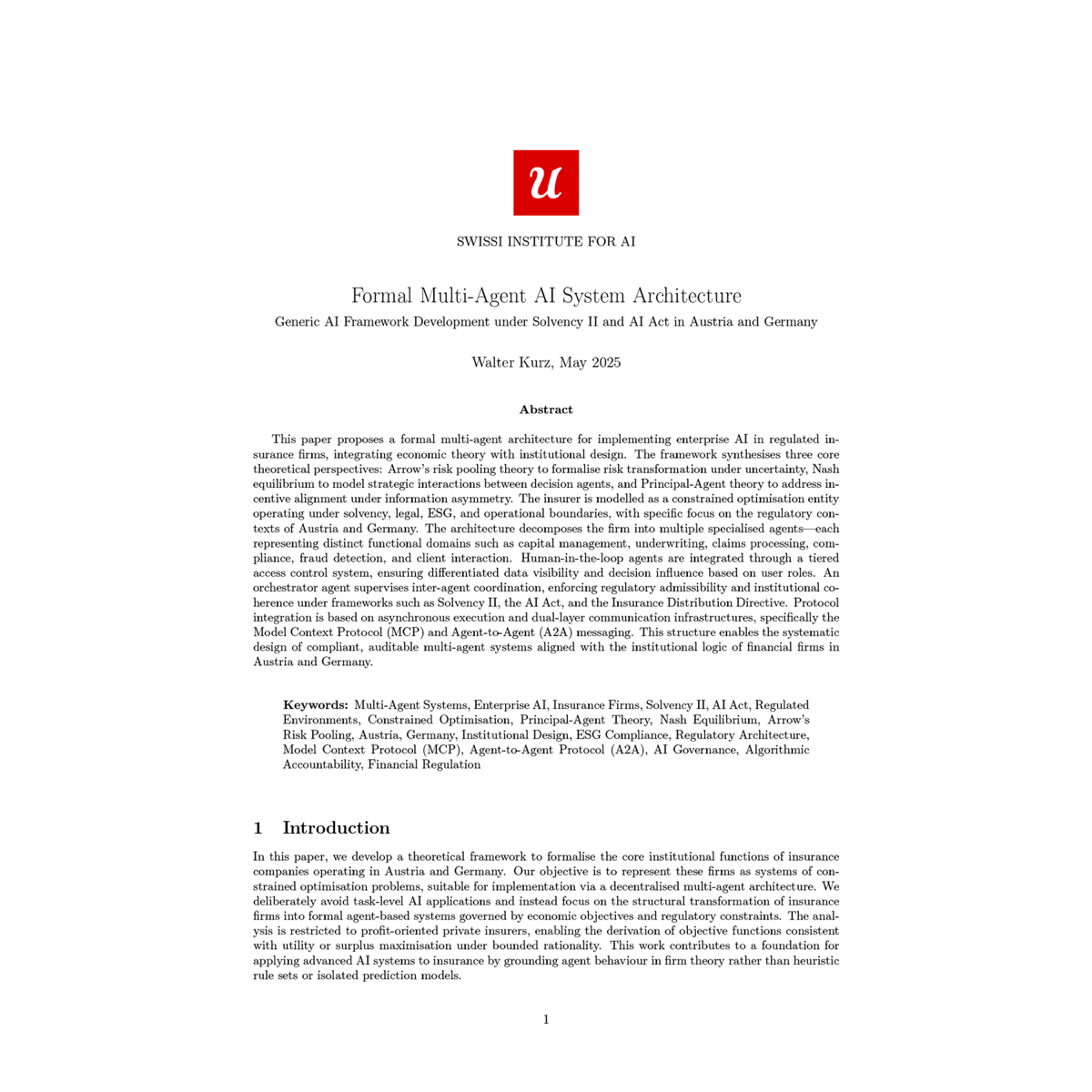
Multi-Agent Insurance Architecture
Our research formalises insurance firms as distributed decision systems using Arrow, Nash, and Principal-Agent theory. We translate core profit and risk functions into operational optimisation engines with embedded regulatory compliance.
Through collaboration with Austrian and German regulators, we ensure alignment with Solvency II, AI Act, GDPR, and ESG frameworks while enabling real-time underwriting and capital allocation decisions.
Swissi Authors: Prof. Dr. Walter Kurz
Protocol Integration
A dual-stack foundation for robust, auditable multi-agent systems combining asynchronous operation with explainable, persistent decision memory.
Model Context Protocol (MCP)
Governs semantic coherence and memory persistence. Structures context propagation and state retention, enabling agents to reason over shared histories, hierarchical goals, and environmental signals.
Functions as the institutional memory layer—necessary for consistency, justification of contingent decisions, and compliance transparency.
Agent-to-Agent Protocol (A2A)
Standardises inter-agent messaging across frameworks like LangGraph, CrewAI, and AutoGen. Defines shared syntax for intention, memory, and task state.
Enables coordination between heterogeneous components—an LLM-based compliance module and a rule-based pricing agent can exchange structured decisions seamlessly.
Target Markets: Austria & Germany
Two of the most developed and stringently regulated insurance markets in Europe. Both jurisdictions operate under Solvency II, characterised by high market penetration, standardised supervisory practices, and formally codified capital adequacy regimes.
BaFin
German Regulator
FMA
Austrian Regulator

Key Differentiators
Proprietary
Infrastructure
Not built on open platforms. Institutional-specific objective functions with full data sovereignty.
Embedded
Compliance
Regulatory constraints integrated into decision logic, not applied as external filters.
Formal
Foundations
Grounded in firm theory—Arrow, Nash, Principal-Agent—not heuristic rule sets.
Auditable
Architecture
Full traceability with persistent decision memory for regulatory review.
Access the full details
Register as a qualified partner to view complete technical specifications, financials, and partnership terms.
Not a partner? Contact us for partnership inquiries