Swissi
DLT
DAG-based distributed ledger with two-layer architecture — native token and enterprise settlement
Our Own DAG Network
We operate a very fast and secure transaction processing system — full regulatory compliance. Built for FINMA, BaFin, and FMA approval.
A purpose-built distributed ledger for regulated financial transactions, enterprise settlement, and cross-company data exchange. DAG-based architecture for parallel processing, near-instant finality, and horizontal scalability without traditional blockchain limitations.
"Institutional infrastructure requires institutional-grade technology. The Swissi DLT delivers the performance, privacy, and regulatory compliance that enterprise clients demand."— Swissi Founders
Enterprise needs regulated settlement infrastructure. Traditional blockchains are too slow, too expensive, and lack the privacy controls required for institutional use.
Two-layer DAG architecture with native token. L1 Hornet for universal settlement, L2 application networks for custom logic—delivering 10,000+ TPS with sub-second finality.
Two-Layer Architecture
Separation of concerns between the settlement layer and application-specific networks enables scalability, privacy, and regulatory compliance at every level.
Layer 1
Swissi Hornet
The universal settlement layer for the entire Swissi ecosystem. All ecosystem participants—companies, operators, validators—connect to Layer 1 for final settlement, cross-network transactions, and native token operations.
- —Global state consensus
- —Native token issuance and transfer
- —Cross-L2 message passing
- —Validator coordination
Layer 2
Application Networks
Dedicated networks for specific use cases and organisations. Each L2 network inherits security from Layer 1 while providing custom logic, privacy controls, and throughput optimisation for its specific requirements.
- —Application-specific smart contracts
- —Custom privacy and access control
- —High-throughput local processing
- —Periodic L1 anchoring
Layer 1: Swissi Hornet
The Hornet node implementation provides the foundation for the entire Swissi distributed ledger. Based on DAG consensus, it enables feeless value transfers, data anchoring, and decentralised identity without the energy waste of proof-of-work or the centralisation risks of delegated systems.
Every Swissi ecosystem participant operates through Layer 1—from the Data Centre nodes validating transactions to the AI companies settling payments in native tokens.
The DAG structure allows parallel transaction processing: unlike sequential blockchains, multiple transactions can be confirmed simultaneously, enabling throughput that scales with network participation.
Parallel transaction processing
Confirmation time
No gas costs for basic operations
Directed Acyclic Graph structure

Immutable Transaction Ledger
Every transaction on the Swissi DLT is cryptographically linked to previous transactions, forming an immutable record of all ecosystem activity. The DAG structure enables this without the bottlenecks of sequential block confirmation.
Full audit trail visibility for regulators, real-time settlement tracking for operators, and cryptographic proof of every state transition—from token transfers to smart contract executions.
Layer 2 Networks
Dedicated application networks for Swissi ecosystem companies and external partners. Each network operates with custom parameters while anchoring to Layer 1 for security.
UniAI Network
Academic credentials, research data, student records
- —Credential verification
- —Research data provenance
- —Cross-institution transfers
FinAI Network
Financial transactions, treasury operations, audit trails
- —Transaction settlement
- —Regulatory reporting
- —Multi-sig treasury
InsAI Network
Insurance claims, policy records, actuarial data
- —Claims processing
- —Policy attestation
- —Risk pool coordination
LegalAI Network
Contract execution, legal records, dispute resolution
- —Smart contract escrow
- —Document anchoring
- —Timestamping
Data Centre Network
Compute marketplace, node coordination, resource allocation
- —Workload scheduling
- —Operator rewards
- —SLA enforcement
Partner Networks
External organisations with custom requirements
- —Custom governance
- —Private transactions
- —Dedicated validators
Native Token
The native utility token of the Swissi DLT serves as the coordination mechanism for the entire ecosystem—from validator incentives to cross-network settlement.
Utility Functions
- 01Validator staking and rewards
- 02L2 network deployment fees
- 03Cross-network message fees
- 04Governance participation
Payment Integration
The native token will serve as a payment instrument across the Swissi ecosystem, enabling direct settlement between ecosystem participants without fiat conversion.
Combined with the sCHF and sEUR stablecoins, this creates a complete digital payment infrastructure for both volatile and stable-value transactions.
Tradable on Exchanges
The SWIS token will be listed on regulated exchanges, enabling price discovery and liquidity for ecosystem participants. Token holders can trade freely while maintaining full compliance with Swiss and EU securities regulations.
Unlike utility tokens trapped in closed ecosystems, SWIS provides genuine economic value through staking yields, governance rights, and direct utility in the Swissi infrastructure.

Technical Architecture
Consensus Layer
- 01DAG-based transaction ordering
- 02Byzantine fault tolerance
- 03Probabilistic finality
- 04Validator committee rotation
Execution Layer
- 01Smart contract runtime
- 02WASM-based VM
- 03Deterministic execution
- 04State transition proofs
Data Layer
- 01Distributed storage
- 02State pruning
- 03Archive node support
- 04Cross-shard data access
Our Own Research Powers the DAG
Every ecosystem company operates on peer-reviewed foundations. Six domains. Six papers. One distributed ledger.
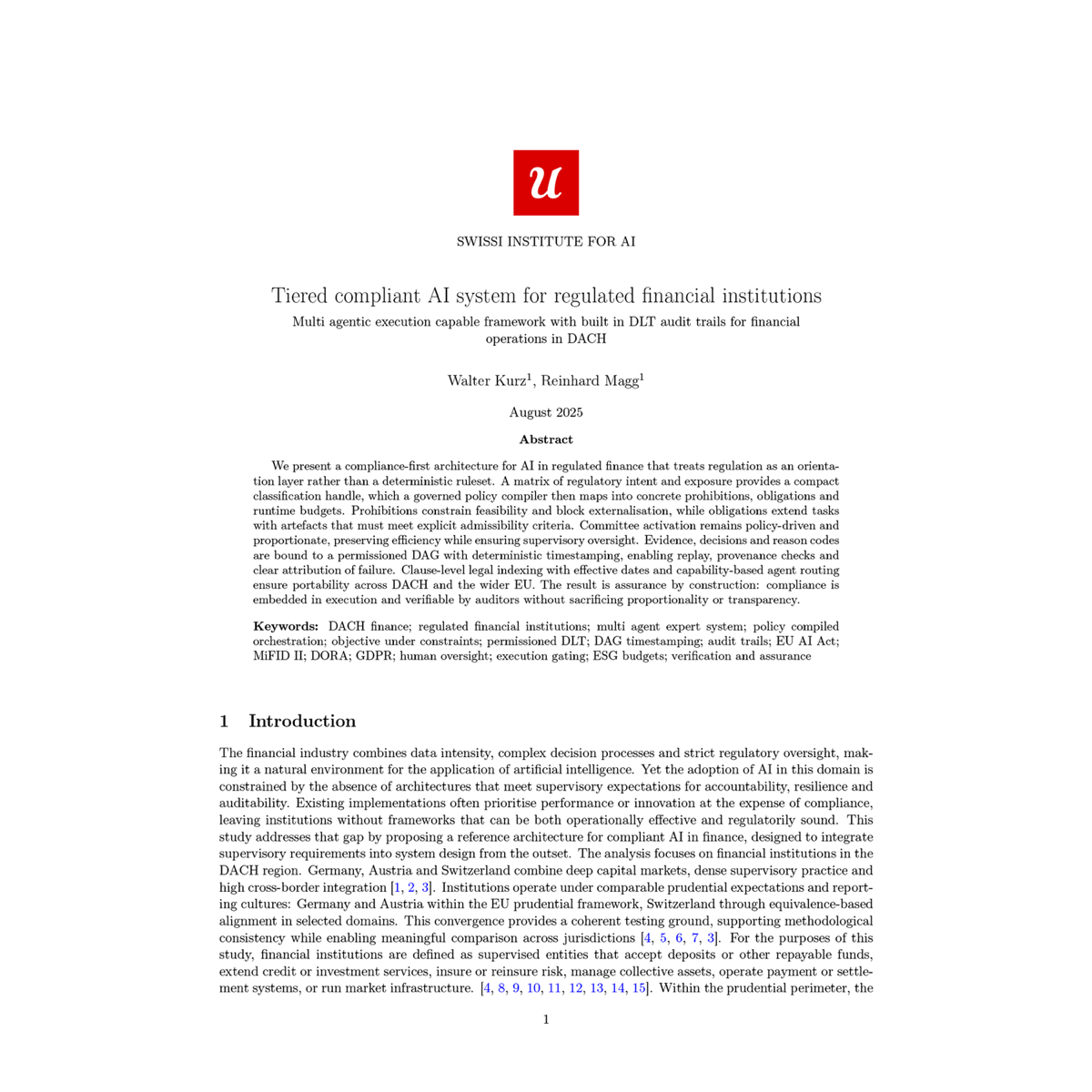
FinAI
AI-powered treasury management with DAG-native transaction settlement. Every financial operation is recorded with cryptographic proof and instant finality.
Swissi Authors: Prof. Dr. Walter Kurz, Reinhard Magg
InsAI
Insurance operations anchored to the DAG. Claims, policies, and actuarial data with immutable audit trails and regulatory-grade provenance.
Swissi Authors: Prof. Dr. Walter Kurz
UniAI
Academic credentials verified on the DAG. Research data provenance, student records, and cross-institution transfers with cryptographic attestation.
Swissi Authors: Prof. Dr. Walter Kurz, Michel Marla, Wojtek Stricker
P3 Energy
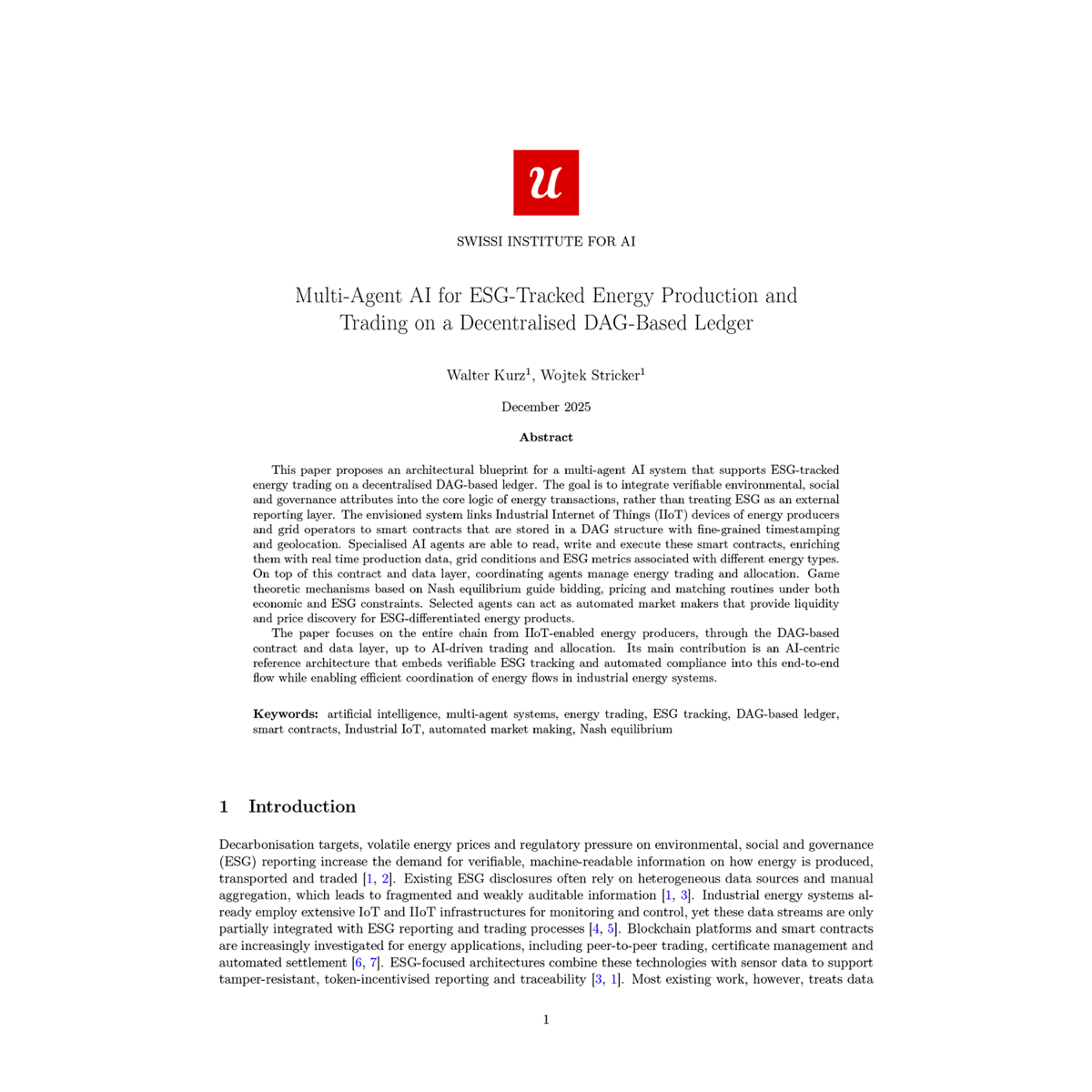
Energy certificates and carbon credits tracked on the DAG. Every kilowatt-hour and emission reduction verified with full chain-of-custody from source to market.
Swissi Authors: Prof. Dr. Walter Kurz, Wojtek Stricker
Data Centre
Compute marketplace coordinated by the DAG. Node scheduling, operator rewards, and SLA enforcement with transparent, verifiable execution.
Swissi Authors: Prof. Dr. Walter Kurz, Wojtek Stricker, Prof. Dr. Velimir Dedić
Agnostyca
AI model versioning and inference billing on the DAG. Training attestation, model provenance, and usage tracking with immutable records.
Swissi Authors: Prof. Dr. Walter Kurz, Michel Marla, Prof. Dr. Velimir Dedić
Why DAG over Blockchain?
Traditional blockchains process transactions sequentially—each block must wait for the previous one. This creates fundamental throughput limitations regardless of hardware improvements.
Directed Acyclic Graphs allow parallel processing: multiple transactions can reference different parts of the ledger simultaneously. Throughput scales with network activity rather than being constrained by block times.
For enterprise applications requiring high transaction volumes—payment processing, IoT data anchoring, supply chain tracking—DAG architecture provides the scalability that sequential blockchains cannot match.
Multiple transactions confirmed simultaneously
No waiting for block intervals
No congestion-based pricing
More activity = more throughput
Ecosystem Integration
The DLT serves as the settlement and coordination backbone for all Swissi infrastructure.
Infrastructure Layer
- 01Data CentreNode coordination, compute settlement, SLA tracking
- 02P3 EnergyEnergy certificates, carbon tracking, grid settlement
- 03StablecoinNative token bridge, reserve attestation, mint/burn
Application Layer
- 01Swissi AI CompaniesFinAI, LegalAI, InsAI, UniAI, PharmaAI settlement
- 02AgnostycaModel versioning, training attestation, inference billing
- 03External PartnersCustom L2 networks, API access, validator participation
Roadmap
- —Hornet node deployment
- —Testnet launch
- —Validator onboarding
- —Core protocol finalisation
- —Mainnet launch
- —Native token generation
- —First L2 networks
- —Stablecoin integration
- —Token trading enabled
- —Additional L2 networks
- —External partner onboarding
- —Cross-chain bridges
- —Full ecosystem rollout
- —Decentralised governance
- —Public validator program
- —Enterprise partnerships
Key Differentiators
Purpose-Built
Not General-Purpose
Designed for regulated enterprise transactions, not speculative trading.
Two-Layer
Not Monolithic
Separation of settlement and application for scalability and privacy.
DAG-Based
Not Sequential
Parallel processing for throughput that scales with network activity.
Ecosystem-Native
Not Isolated
Deep integration with all Swissi infrastructure and applications.
Access the full details
Register as a qualified partner to view complete technical specifications, tokenomics, and partnership terms.
Not a partner? Contact us for validator or partnership inquiries